By STEVE HATHCOCK
Special to the PRESS
Charles Canny emailed me and asked “What’s the story behind Padre Island’s name?”
Padre Nicholas Balli, for whom the Island gets its name, was the first European to bring ranching to the Island. He and his nephew Juan founded El Rancho Santa Cruz de Buena Vista (later known as the Lost City), where he kept cattle, horses and mules. The actual ranch and outbuildings, located about 26 miles north of the Islands southern tip, were little more than thatched huts known as jacals. Because of its natural fences of water, the Island was a perfect spot for raising livestock.
In his will, written in 1811, Padre Balli stated that he owned 1,000 head of cattle. In addition to his large herds of cattle the Padre also built the first church on the Island for the conversion of the Karankawa Indians and for the benefit of the ranch hands and their families. Ironically, Balli never lived on the Island that bears his name today. He left the day-to-day operations of the ranch to his nephew Juan, who also held title to a sizable amount of the Island. The Padre spent most of his time on the mainland ministering to the spiritual and material needs of his people.
Padre Ballí died on April 16, 1829 and was buried near Matamoros. For many years during and after Balli’s ownership, the Island was called various names including St. Bagin Isla de Boyan, Ysla del Vallin and Isla de Santiago. Juan operated the ranch until the storm of 1844, after which he moved to the mainland. The ranch was abandoned, but only a few short years would pass before its new occupants arrived on the scene.
The first reference to the name of Padre Island was in the April 24, 1841 Edition of a British publication by the name of “The Old London Newspaper.” The editor wrote “Notes from Matamoras bring no news of importance. All was quiet there, and the talk of a war for the re-conquest of Texas had ceased. Three Texans who had served with General Canales were killed on Padres Island.” (A force of about fifty men, the entire company of Minute Men of San Patricio, and a few volunteers from Gonzales had staged a surprise raid to the southern tip of the Padre’s Island. A Mexican Captain and nine soldiers stationed at a rancho were captured and taken back to San Patricio to await a prisoner exchange for some Texians being held in Matamoros. Statements made by the prisoners and a group of Irish settlers living on the extreme southern tip of the Island confirmed the Mexican forces numbered only one hundred regular infantry stationed in Matamoros and a handful posted throughout the interior.)
The New York Tribune was the first American newspaper to adapt the new name; in its January 3, 1842 edition, the editor reported “Several enterprising citizens of the West, have for some months past been engaged in the transportation of salt from a bayou near Padre Islands, to the Western ports. Many hundred bushels of this salt have been removed and sold at the rate of 4-6 bits a bushel.”
The name stuck and by 1844 the Island was almost exclusively referred to as” Padre Island.”
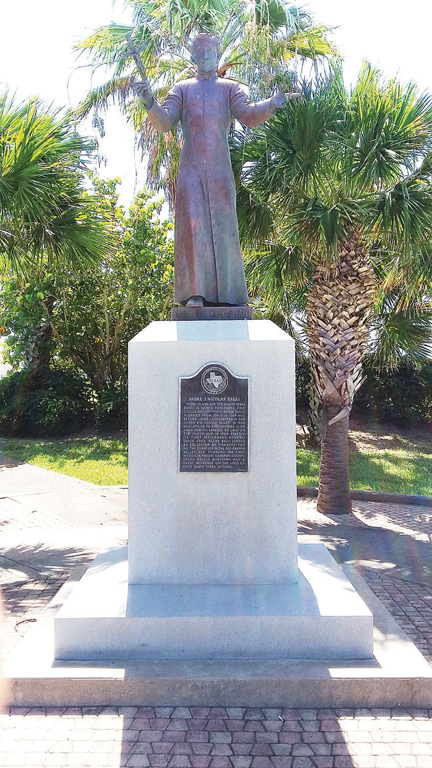
Today, a statue of Padre Balli with outstretched arms in greeting, stands at the eastern foot of the Queen Isabella Memorial Causeway on South Padre Island Texas.
Want the whole story? Pick up a copy of the Port Isabel-South Padre Press, or subscribe to our E-Edition by clicking here.







Comments