
By CATHERINE DONNELLY
Special to the PRESS
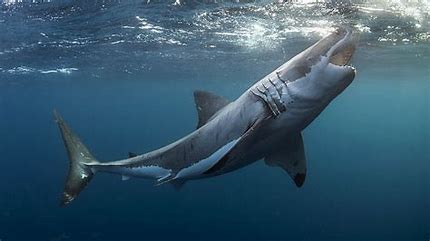
LeeBeth is the 2,600-pound female great white shark that has experts intrigued as her tag pinged near SPI shore.
On December 8, a satellite tag was placed on her off of Hilton Head, South Carolina, by Captain Chip Michalove of a fishing charter company called Outcast Sport Fishing, according to Higher Calling Wildlife.
“14’ Great White “LeeBeth” is covering some crazy ground, pinging in today right off the beach near the Mexican border. The furthest West, a white shark has been tracked from the Atlantic. She’s now covered over 2,000 miles since we caught her in December. Insane, I had no idea.”—according to a tweet by Chip Michalove (@ChipHHI) on February 27, 2024.
In the off-season, Michalove works with the Atlantic White Shark Conservancy (AWSC) to tag the great white sharks he catches. The AWSC’s mission is to “support scientific research, improve public safety, and educate the community to inspire white shark conservation,” according to its website.
Great Whites are designated and must be immediately released if caught. According to the National Oceanic and Atmospheric Administration (NOAA), they are a prohibited species in all U.S. waters and fisheries. In the U.S., Atlantic waters range from Maine to the Gulf of Mexico and the Caribbean. In the U.S. Pacific, they range from Alaska to California and Hawaii.
News of LeeBeth concerned locals as her tracker pinged near Brownsville on Wednesday, February 28, and only 100 yards offshore.
Frontera Rio posted on Facebook that they felt concerned that the massive Great White pinged close to South Padre Island, saying to be on alert with her lurking in the neighborhood. Others chimed in the comments with “yikes” and other words of general panic.
Other posts were more flippant, like Rosell Elizondo’s posting to the South Padre Island Concierge group, “I mean yeah, it’s their ocean (laughing emoji).”
Jamie Cantu added, “They need food…. any hefty volunteers (LOL emoji).”
The voice of reason from Kimberly Bennett-Walsdorf reads, “Looks like she came along SPI, went south about 110 miles… then turned back north and out into deep water. You can see where she has been on the tracker. It’s interesting, but I’m glad I’m not in the water!”
Those interested in tracking such things can look to Sharktivity, a free shark activity tracker created by the AWSC. The application gathers verifiable data from researchers, safety officials, and the public. The signal is transmitted when the tagged fin surfaces and LeeBeth’s pings have allowed great tracking of her movements.
Although LeeBeth isn’t the first of the tagged sharks to appear in the Gulf of Mexico, the AWSC reports this is the farthest West a white shark has ever been spotted in the Gulf, most stopping near the Mississippi River.
Although Great Whites are considered an apex predator, it is rare for them to be sighted near or cause problems for Texas beachgoers, with the latest bite recorded in Corpus Christi in 2022, according to the Houston Chronicle. According to Texas Monthly magazine, in 1962, a surf fisherman carrying a stringer of fish around his waist was severely bitten by a shark and died near South Padre Island. It’s important to know that sharks frequent the area, but overall, they are not a general concern.







Comments