
By: M. Kathy Raines
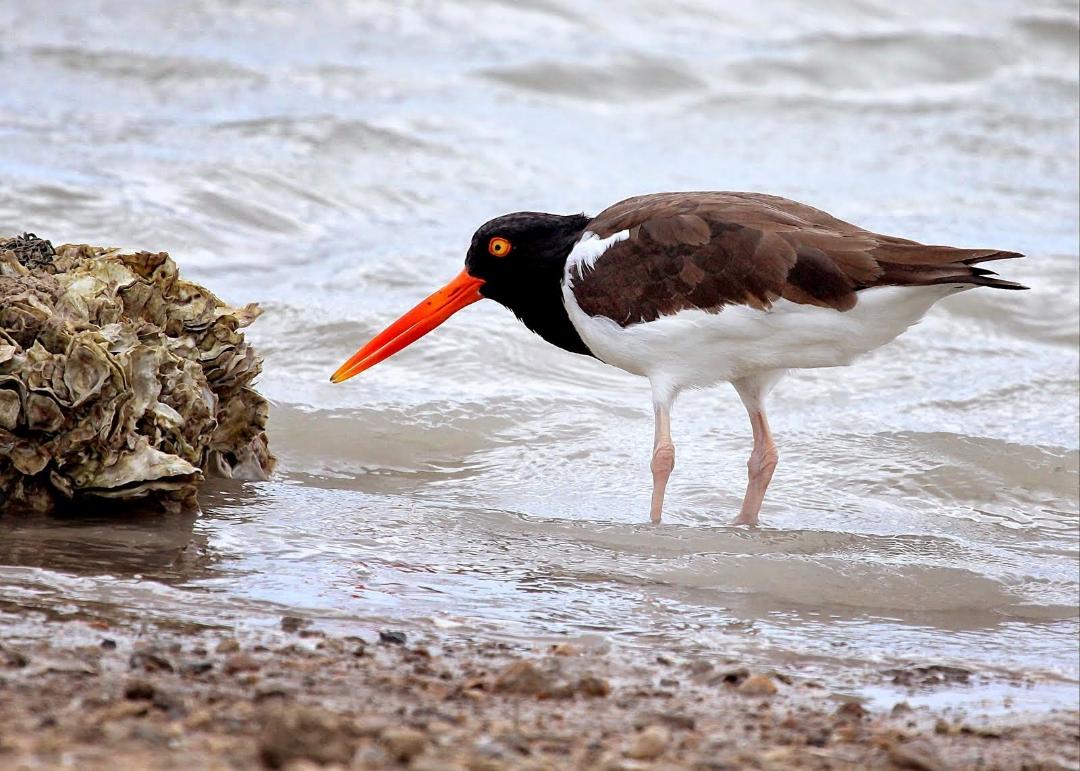
A reddish bill protrudes from its black head like two sliced carrots. Open, the bill suggests bright orange scissors. Its yellow eyes lie cushioned in a bright coral ring. This is one distinctive-looking shorebird.
Struggling to properly identify shorebirds—many, especially sandpipers, a similar grayish color—I much appreciate this large, unmistakable one, the American oystercatcher. The far more abundant black skimmer has a similarly reddish but black-tipped bill, and its lower mandible—used like a spatula to scoop up fish— protrudes noticeably.
Spotting a few American oystercatchers browsing and preening along the channel at the Jaime Zapata Memorial Boat Ramp & Kayak Launch Area this June provided a rare treat. Javier Gonzalez, Naturalist Educator at the South Padre Island Birding Nature & Alligator Sanctuary, said personnel and visitors see these oystercatchers “from time to time year-round, especially during really low tides that expose the oyster beds close to shore,” adding that they are always “a great sight!”
The American oystercatcher (Haematopus palliatus) stands from 17 to 21 inches tall. Its head and neck are black, its back, chocolate, its underparts white, and its legs, pink. Youths’ bills are dark-tipped, and young chicks’ are hooked. Its genus name, inspired by its rosy legs, derives from Greek haima for “blood” and pous for “foot”. Its species name, from Latin pallium, meaning “cloak”, likely refers to its brown-feathered mantle.
The American oystercatcher lives year-round along the coasts, mudflats and estuaries of the U.S., around Mexico, Argentina and Chili and up towards California, where it sometimes hybridizes with the black oystercatcher. Though it winters farther south, it has bred as far north as Nova Scotia. Migration varies, depending upon climate and food supplies.
Regarding our local oystercatchers, Justin Leclaire, Avian Conservation Biologist with Coastal Bend Bays & Estuaries Program, said, “My best estimation is that we have around ten breeding pairs in all of the Lower Laguna Madre.” We do not have more, he posits, “due to the lack of oysters here thanks to the hypersalinity/lack of flow from the Gulf in the Laguna Madre,” adding that neither are they common, albeit more so, in the Upper Laguna. “They are one of the heaviest shorebirds in North America,” he said, “so they need quite a bit of food to sustain that bulk.”
Form follows function in the avian world, and an oystercatcher’s long, flattened bill suits its needs perfectly. Dining chiefly on mollusks, the oystercatcher secures a bivalve, like a clam or oyster, then, finding a small opening, thrusts in its bill, snapping the creature’s abductor muscles— those which enable it to open and shut its shell. This requires some risk: an oyster occasionally clamps down on the bird’s bill, perhaps leaving it to drown in rising tides. Also, an oystercatcher may select a shellfish and hammer it open. Feeding tactilely, it also probes the mud with its bill to catch small marine invertebrates like crustaceans and worms.
Though oystercatchers forage at the Boat Ramp along San Martin Lake, with its “vast expanses of oysters”, Leclaire says they have more success nesting “on spoil islands”—assemblages of dirt, rock and other debris which arise from dredging— “or peninsulas sticking out into the bay where there are fewer ground predators.” These nesters often, he says, “move over to the mudflats on the back side of South Padre Island” afterwards and sometimes to the beach. Leclair notes that bird banding has revealed that “a number of these birds return to their same nesting sites each breeding season.”
Oystercatchers in Texas may defend breeding territories as early as January, with naturalists reporting the earliest clutch on January 22. Like other birds, they engage in courtship rituals. A couple may walk parallel, piping one note and stretching necks forward, up and down. Sometimes they run alongside each other, heads bobbing, piping loudly, then faster, with changes in pitch. They may fly parallel, piping long notes. Often nearby bird pairs join in, creating what naturalists dub a Piping Ceremony, a grouping that moves from ground to air.
Both, but chiefly the male, scrape out several shallow ground nests with their feet a few weeks prior to courtship. The pair selects one in which to lay two or three eggs. Occasionally, oystercatchers in Florida nest upon gravel roofs. Both birds tend the eggs. A day or two before hatching, a nestling vocalizes within the egg, makes a star-shaped break and emerges. A precocial (independent) chick leaves the nest in a few hours. Chicks stand and run a little within hours. In about ten days, they swim and dive, making sustained flights in about thirty-five. Parents continue feeding and instructing them in foraging techniques.
These rather noisy birds make long, gently rising hueep calls, generally during flight. An intensifying hueep or weeer prior to takeoff sometimes signals alarm, but it may arise during nonbreeding gatherings. An alarmed, nest-defending adult may pip or wip in distress, which intensifies as an intruder nears. The oystercatcher flies with fast, deep wingbeats except when courting or defending territory. Though chicks swim and dive, adults rarely do so.
Before the Migratory Bird Treaty Act of 1918, the American oystercatcher faced possible extinction from hunting and egg-gathering, but its populations rebounded and are now considered stable. Since 2014, however, it has been on the State of the Birds Watch List. It faces the dilemmas of other shorebirds: an increase in nearby human recreation—which discourages nesting—habitat loss and degradation, a decline in water quality and flow, rises in sea level and overwash from boat wakes, storms and even normal tides. The oystercatcher is also vulnerable to avian and mammalian predators, including domestic dogs and cats.








Comments