
By: Trina “Indi” Johnson
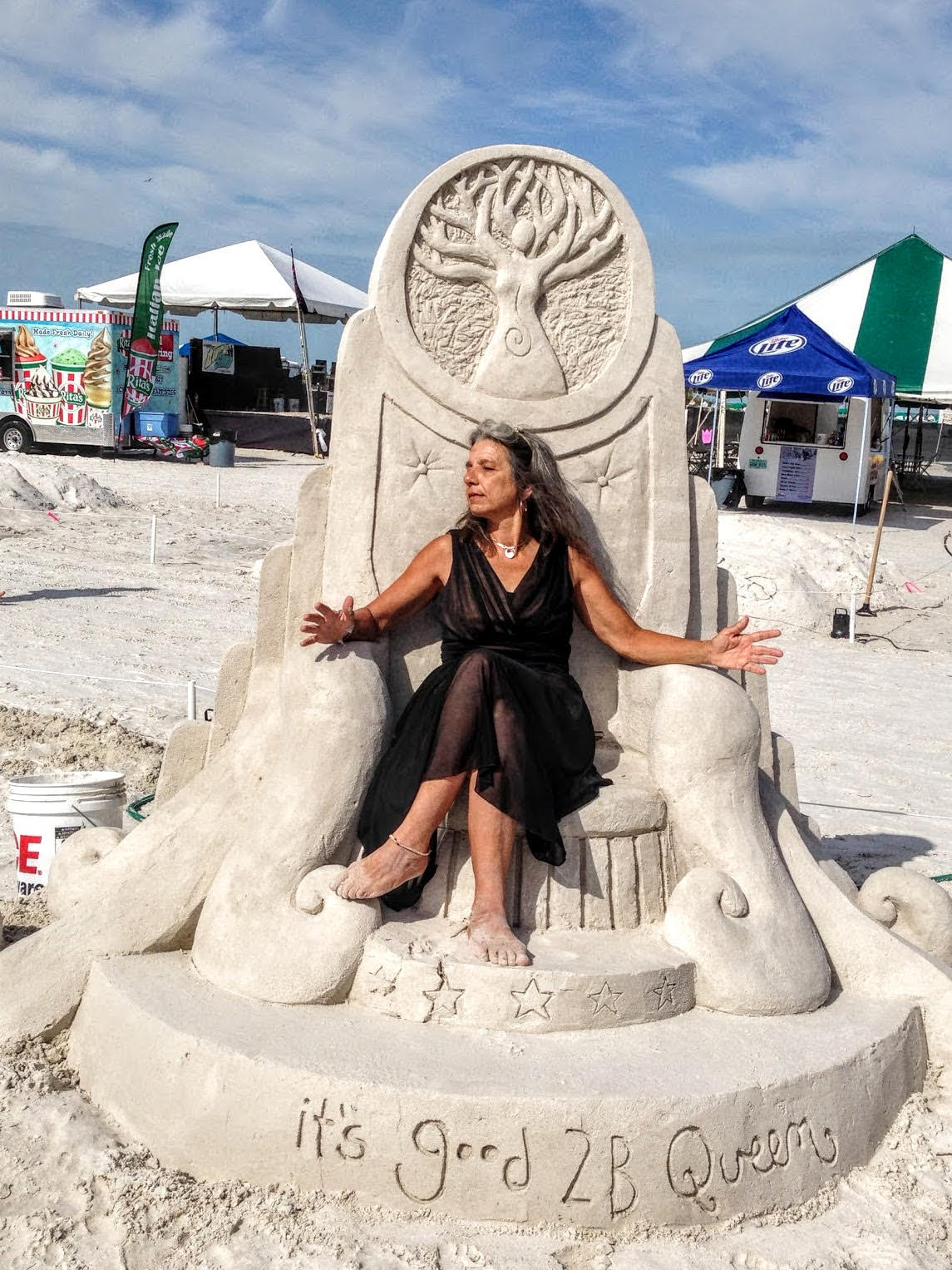
Lucinda “Sandy Feet” Wierenga has been shaping sand for more than four decades, transforming grains into towering castles, intricate figures, and fleeting masterpieces that live in memory long after the tide claims them. Her journey began in Weslaco, where she was a high school English teacher. “I met Amazin’ Walter. He was building these cool little castles and once he showed me how, I was hooked. We partnered up for years, culminating in an invitation to the World Championship in Harrison Hot Springs, British Columbia around 1989,” she said.
Each pile of sand she approaches is a challenge waiting to be realized. “Something that needs to be moved! A pile of sand is lazy – it just wants to lay there. It has to be packed with water. Usually into forms though we also do a lot of ‘handstacking.’ Since sand is heavy you want to have a pretty good idea of what you are going to do with it before you move it,” Wierenga explained. Her work demands foresight, strength, and an intimate understanding of the medium’s fleeting nature.
The beach itself exerts influence over every creation. “The main concern is to be close to the water source – we need a LOT of water to do what we do. Wind can dry things out fast. I am fond of saying that a sand sculpture’s temporary nature is part of its charm. You enjoy a sand sculpture the way you enjoy a rose,” she said. That impermanence, far from discouraging, fuels her creativity.
Play and imagination are central to Wierenga’s process. “So many people seem to believe that ‘play’ is just for kids, but we never stop benefiting from using our hands and our imaginations to create. Sand is perfect for it, as there is so much of it and once you know a few tricks, you can very quickly create something you have imagined. And if you don’t like it, you just keep carving until it falls down — and start all over again,” she said. Her philosophy encourages both children and adults to embrace curiosity, experimentation, and joy.
Teaching has been a constant thread in her career. “The joy of creating something in a place nearly everyone loves – the beach!” she said. Beyond imparting technique, Wierenga hopes students carry away a sense of wonder and personal accomplishment. Competition, too, plays a role in honing her artistry. “Competition is actually where creativity comes to the fore. Most sand sculptor’s bread and butter is commercial work where they are required to bring someone else’s vision to life. For example – my next gig will be in a hotel lobby in southern California where the list of what the client wants is a long one – though I have a certain amount of freedom in bringing all of the elements together.”
Some of her creations linger in memory even after they are gone. She recalls “Going to the Chapel,” a late-1990s piece featuring two brides walking to a wedding chapel before same-sex marriages were legal. The sculpture caused “a bit of an uproar in conservative NH,” yet it remains vivid in her mind.
Persistence, she says, is perhaps the most unexpected lesson sand has taught her. “No art teacher ever saw promise in me – I thought I was going to be a rock n roll star! – yet I have made my living as an artist for 40 some years. I just needed a pile of sand and lots of inspiration from the people with whom I surrounded myself,” she said.
Wierenga envisions a legacy that extends beyond her own work. “I really hope the Sandcastle Village lives on forever – maybe with a roof to replace the tent – taking full advantage of melding AI effects with the skills of human 3-D artists. And, of course I would like to be around for the 50th Annual Sandcastle Days though I probably won’t be here for the 75th,” she said.
To outsiders, sand sculpting may seem simple, but Wierenga emphasizes its demands. “It’s not just for little kids. The adults and older children who instantly connect with sand often remark that carving can bring them to an almost meditative state. The people around you barely register. The fabled state of Flow. It’s magical,” she said.
South Padre Island holds deep personal significance. “The first time I drove across that bridge back in 1980, I knew that I would find a way to be here. I lived in Isla Blanca Park with the surfers and the artists and I played in the sand and made music with Amazin’ Walter. I dropped out of teaching and I wrote three sandcastle books while I learned to make websites to reach a larger audience. I invested in Island property when such a thing was still possible for a self-employed artist. I got to travel to beaches all over the world, but considered it a privilege and an honor to return to my home on this spit of sand,” she said.
Hard work is constant, she notes. “Probably that it isn’t hard work. Sand is heavy. Water is heavy. Requires a strong back and a light touch,” Wierenga said. Each piece has its own life, finished not in perfection but in expression. “No piece is ever truly ‘finished.’ It is just abandoned… for any of a multitude of reasons. Most commonly – this piece says what I needed it to say,” she said.
Looking back, Wierenga marvels at the unexpected path sand has carved in her life. “The fact that it has taken me to my current life: Doing exactly what I want to do in the exact place where I want to be, with a perfect companion and a happy pack of critters. I feel very very fortunate,” she said.
Through her creations, teaching, and competitions, Sandy Feet has shown that sand is more than a medium. It is a canvas, a challenge, and a playground, all at once, and she has mastered it with imagination, patience, and enduring joy.







Comments