
By STEVE HATHCOCK
Special to the PRESS
The great amount of wealth flowing from the mines in her colonies, presented the Spaniards with an unusual logistical problem. Expanding an empire called for commerce with other countries. (It would be four hundred years before the Euro-dollar would be conceived). A way had to be developed to make the bullion easier to transport and easy to convert to other monetary standards in place at the time. Thus it was that the so called, “Cob” coinage was developed. In his standard catalog of Mexican Coins, Paper Money and Medals, numismatic expert, Dr. George W. Vogt, says this of the Spanish coins known as “cobs”: “They were minted in the New World, from approximately 1580 to 1732. The term “cob,” derives from the Spanish “Cabo de barra” which translates as “end of the bar” or “cut from a bar.” Either term applies when it relates to the crude coins produced in Spain’s Colonies.”
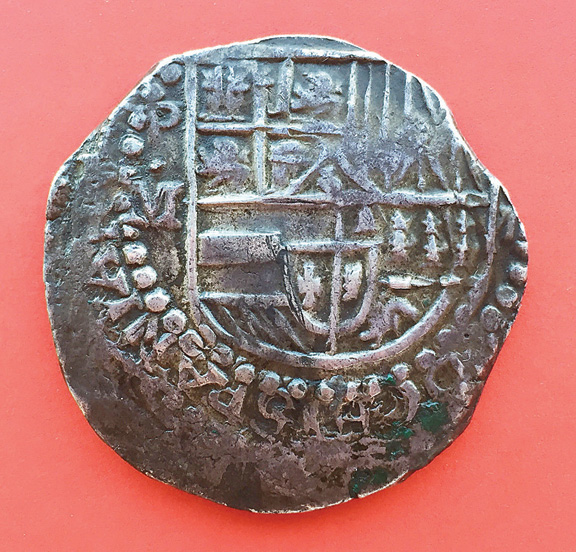
The freshly mined silver was first smelted into bars. Pieces were then sliced off and trimmed until the right weight was reached. The resulting disk, or planchet, was placed in an anvil mounted die. The coiner then struck the upper part of the die with a hammer, inscribing the crudely shaped coin with a year date. The King’s shield was on the obverse and a cross on the reverse. (This showed the mating of the Church and the State). Because of the coins irregular shape and thickness many of these details were either very weak or missing altogether. The single most important detail to be inscribed though; (and every effort was made to accomplish this,) was the assayer’s initials. He was the man who guaranteed the purity of the coins bullion and there were very severe penalties for allowing a coin to reach circulation without his permanent stamp of approval.
The cobs, produced in denominations of, half, one, two, four and eight reales, were mass produced by local Indians at a fraction of the cost of conventional minting. Great amounts of the cobs were hammered out over the next 150 years.
The problem with these crudely produced coins was that they had no uniformity and thus could be easily altered. Dishonest merchants routinely shaved the edges of each coin, removing a fraction of silver with no one the wiser. Because of this, it became necessary to weigh the coins before accepting them in trade. Also, the crudeness of the coins made it easy to counterfeit. These problems made the cob an unpopular coin and with the introduction of the pillar dollar in 1732, the cob faded into obscurity. Over the last several hundred years, those in circulation were melted down and re-minted into other coins or jewelry. Only those found in treasure troves lost at sea or buried deep in some dusty vault escaped destruction.
Their numismatic value depends on the mint, year, and denomination. Coins such as those found by Mel Fischer from the Atocha or other well known wrecks have a higher value because of their historical interest. The eight reales coin shown in the photo was minted in Bolivia between 1616-1658 and weighed 27.3 grams and was recovered from a wreck off Puerto Rico in 2001.
Want the whole story? Pick up a copy of the Port Isabel-South Padre Press, or subscribe to our E-Edition by clicking here.








Comments