
By KATHY RAINES
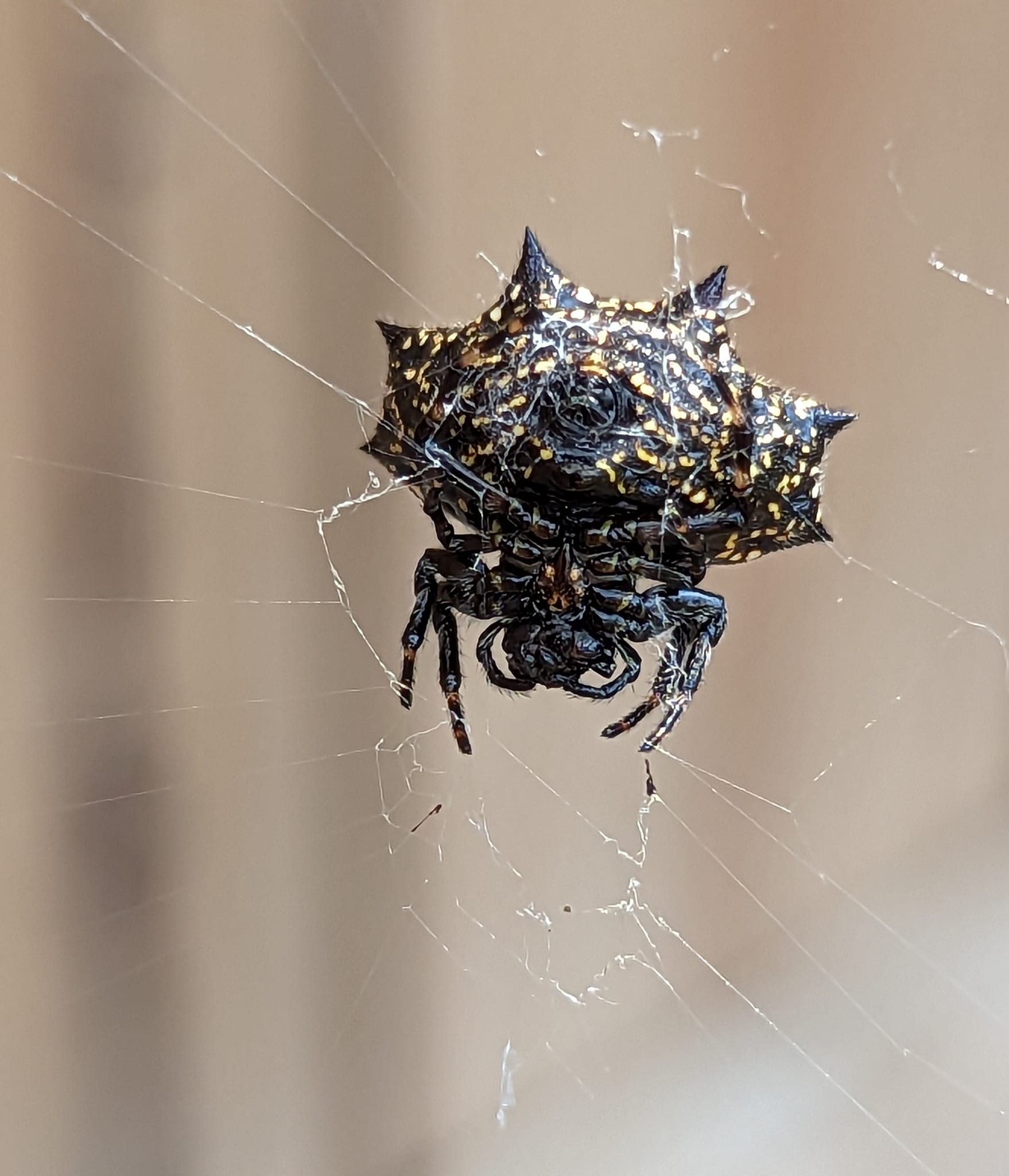
A spiky, ornate gem sat amid an expansive web projecting from the fence, arresting me in my tracks. I feel privileged whenever this decorative creature, the spiny-backed orb-weaver, sets up camp to ensnare tiny insects in my backyard.
Common to gardens, orchards and woodland edges in South Texas and much of the South, the female spiny-backed orb-weaver, the one we’re likely to see, wears a carapace of varied colors, commonly yellow, orange and red, with black spots adorning its upper abdomen. It is fortified with six spines. Wondering if the bright colors served to attract prey, researchers in one study experimented with spiders of various colors, even painting some black or yellow, and found this was not the case, that the colors may, in fact, serve to warn prey.
Unusual for a spider, her abdomen’s width is greater than its length, giving it a crab-like appearance. About half-dime size, she reaches from about a fifth to three-eighths of an inch in length, while a male may reach a mere eighth of an inch. A male has a white-spotted, gray abdomen and small bumps instead of long abdominal spines.
The spiny-backed orb-weaver (Gasteracantha cancriformis) answers to a host of other names, including crab spider, jewel spider, jewel box spider, face spider and crablike spiny orb-weaver, and, in Spanish, araña joya or “jewel spider”, araña soldado, or “soldier spider”, araña panadera or “baker spider”. Its genus name comes from Greek “gaster” for “belly” and “acantha” for thorn. Its species derives from Latin “cancer” for crab and “forma” for appearance.
The female spins durable radial lines, perhaps as many as 30, attached to sticky concentric circles for entrapping prey like flies, beetles and moths. Lying in her central disc, facing downward, she awaits a victim. Sensing its vibrations, she plucks the radii on either side of the disturbance to access its location, then hastens onto the sticky web to seize what she’s caught. Either climbing up the web or swinging a drag line down, she carries a single item to her sitting spot, paralyzes it and, unless it is tinier than she, envelops it in silk. As she bites the prey, she, like most spiders, injects an enzyme that liquifies its innards, which she sucks out, discarding the husk. When ensnaring multiple prey, she paralyzes the creatures and eats them consecutively.
Unlike many orbweavers, the spinybacked orbweaver may spin her web in the daytime, giving spider aficianados the luxury of observing the creatures in daylight. Male spiders, sometimes as many as three, may dangle on nearby threads.
A male visits the web, drumming in a four-tap pattern, and approaches the female. She fastens him down with silk, and they mate, which may last as long as 35 minutes. He remains for a while, since they may mate again. He dies a few days later. Then she expires after accomplishing a few tasks—laying eggs and ensuring her offspring’s survival.
Usually on a leaf’s underside, she attaches, using a special adhesive disc, a platform of loose white and yellowish threads. Upon this, she deposits sacs containing from 100 to 260 eggs, which she coats with a line of rough, dark green threads. Then, she blankets all with a canopy of green and yellow ones. While egg-laying requires about a minute, the rest of the procedure consumes one or two hours. Then, the industrious spider expires.
Eggs generally hatch in the winter, with spiderlings dispersing in springtime, becoming mature in from two to five weeks.
Want the whole story? Pick up a copy of the South Padre Parade, or subscribe to our e-Edition for FREE by clicking here









Comments