By CATHERINE DONNELLY
Special to the PRESS
PORT ISABEL, TX—The sight of shrimp trawlers docked in Port Isabel’s waterways enchants visitors driving through town, an evocative picture worthy of souvenir postcards.
What people don’t realize is that many of those boats would normally be 80 miles out in the gulf catching shrimp, the livelihood that built this town.
The shrimp ecosystem in the Gulf of Mexico spans from the Yucatan peninsula to the straits of Florida and its commercial fishing used to thrive. Almost all brown shrimp caught in the United States comes from the deep waters off the Gulf of Mexico, mainly from Louisiana and Texas, including Port Isabel, according to National Oceanic and Atmospheric Administration (NOAA).
In 2022, landings of brown shrimp alone totaled 53 million pounds and were valued at $95 million, according to the NOAA under the U.S. Department of Commerce’s commercial fishing landings database.
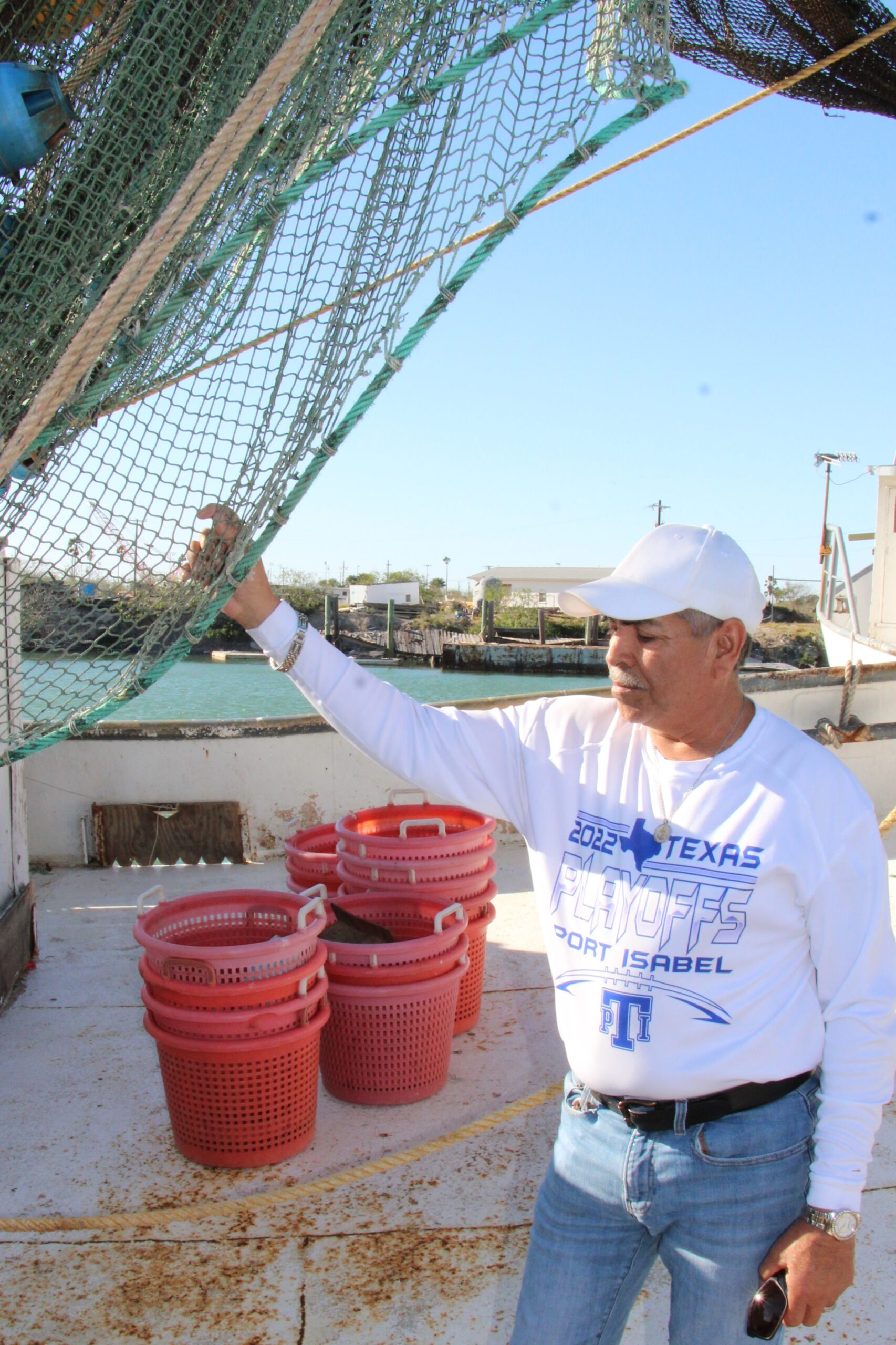
Local captain Victor Manuel Martinez said that he is a second-generation shrimp boat captain who retired after a nearly 50-year career on the unpredictable gulf waters. His father, Israel Martinez, had four boats and made his son a deck hand at only 14-years-old, then a captain four years later. He describes the hard job of going 70 knots offshore and dropping the trawlers two miles down to catch the shrimp.
He recounts memories past, when he was at the helm of one of the original wooden shrimp trawlers back in the day, keeping his crew safe in all kinds of weather and even hurricanes. The ship would go under waves at times, and off of Louisiana, he battled up to 12-foot waves in a recent cold front.
He said, “I never lost one of my crew in all those years,” and he goes on to note, “No one ever went overboard. I always took that part of my job very seriously.”
The Southern Shrimp Alliance (SSA) is an organization of shrimp fishermen and other members of the industry from Texas through the Carolinas. A recent SSA report explains how development funding for shrimp farms crippled the world shrimp market, deeply affecting shrimp industries like the ones in Port Isabel and around the Gulf.
The report entitled; A Crisis of Our Own Making, describes how international lenders and investors created a global excess of shrimp farming over the last five decades. These investors funded the steady development of shrimp aquaculture in Asia, Latin America and other regions. India and Ecuador now dominate the industry causing an oversupply of markets globally.
The report concludes that due to the law of supply and demand, oversupply caused declines in shrimp commodity prices. Shrimp fishermen in our country are struggling to find customers for their catch while their foreign competitors undercut domestic shrimp prices by more than half to hold their market share.
“In the ‘70’s, we sold the shrimp for about $7 or $8/pound dockside. Now, we’re lucky if we can fetch $2.80,” said Victor Martinez. “They really have to care that they’re buying a better quality of shrimp and have the market to sell it to.”
Captain Victor Martinez reminisces when they could profit up to $15,000 in 15 days in the ‘70’s, the equivalent of around $75,000 in today’s dollars, adjusted for inflation. This last trip he took in December garnered 250 boxes each containing 100 pounds of shrimp and he reports that he only profited around $900 after all expenses and paying everyone out.
“It just ain’t worth it anymore,” he said, looking down and shaking his head. He relates how food and fuel prices are too high compared to the dramatically lower prices he can get for his catch.
“The buyers are buying our shrimp for $2.80 per pound, but they’re selling it for a minimum of $12/pound,” said Victor Martinez, “everyone’s making money except the boat captains. That’s why we’re parking our boats and some are just getting completely out of the business.”
Yet, the development of additional shrimp farming continues. In fact, United States taxpayers fund the foreign production of shrimp which, when exported back to the U.S., causes devastation to the country’s own shrimp industry, according to the report.
The report also uncovers the absurdity of how the funding of shrimp farming has led directly to continued deforestation of mangroves in the U.S. and around the world as the farms take over their environment. The U.S. government is simultaneously using taxpayer monies to repair mangroves while separately funding the decimation of existing mangrove ecosystems to make way for more shrimp farms. Mangrove trees have tangled roots which allows the trees to handle the rise and fall of tides and attracts many species of fish and other organisms seeking food and shelter from predators. Mangrove forests are essential to stabilize the coastline, reducing erosion from storm surges, currents, waves, and tides, according to NOAA.
The alliance suggests that U.S. representatives to the financiers should be opposing any new projects that would contribute to “the decimation of mangrove ecosystems to make way for more shrimp farms.”
“All across our southern coast, shrimp boats are tied up and fishermen are not working,” said John Williams, the executive director of SAA. “[And] we are losing businesses every day.”
The President of the United States signed an executive order in 2020, funded through the CARES Act, promoting American seafood competitiveness, calling for the expansion of sustainable U.S. seafood production, which includes both fish farms and the catching of fish in the wild, according to NOAA. It aimed to propel the United States forward as a global seafood superpower by improving the competitiveness of the domestic seafood industry and supporting American workers. And yet, here we are four years later with our fisherman losing their livelihoods and shrimp trawlers being stripped down for scrap as people flee the industry.
The Executive Order specifically calls for regulatory reform of commercial fishing and enforcement of common-sense restrictions on seafood imports that do not meet American standards. It would seem that the government would find a way to step in now since there have been unintended consequences from the quagmire of regulations and laws affecting the jobs of so many in the shrimping industry, bringing it to the brink of collapse.
Starting in 2023, U.S. shrimping communities started to seek state and federal disaster declarations over the low prices for shrimp in the local market, according to nationalfisherman.com. With middle-man buyers currently paying under $1 for a pound for imported shrimp dockside, southern U.S. shrimp fishermen and elected officials are making their case for declarations of a fishery disaster due to the alleged dumping of foreign shrimp into the U.S. market.
The SAA sent a letter to southern governors, including Texas, advising the urgent need for disaster declarations. The letter specifically noted that in 2022 Congress started allowing for man-made disasters to be considered for the federal Fishery Disaster Assistance program and to let the U.S. Secretary of Commerce take action when a fishing industry is hit by one.
“U.S. imports of frozen shrimp nearly doubled from 2013 to 2021 to an unprecedented level of 1.8 billion pounds,” according to the letter. The shrimp imports are “driving prices paid to shrimp fishermen to record lows that cannot cover the costs of a shrimp fishing trip – expenses further exacerbated by historically high fuel prices and inflation,” the letter states.
“Faced with the choice of losing money on a trip – or not being able to sell their catch at all – shrimp fishermen throughout the region remain tied to the dock with no income at the height of the season,” the letter continues.
The U.S. International Trade Commission has maintained anti-dumping duties on frozen warm-water shrimp since 2005 and in June renewed those duties on product from China, India, Thailand and Vietnam for another five years. It’s clear that more needs to be done.
“All across our Southern coast, shrimp boats are tied up and fishermen are not working,” said John Williams, SAA executive director. “This industry operates without a safety net and we are losing businesses every day. Learning that our tax dollars are being used to make the nails for our coffins is too much and requires all of us to say enough is enough.”
Representative Vicente Gonzalez (TX-34) sent a letter to Texas Governor Greg Abbott urging him to formally request a federal fishery disaster determination for local shrimpers along the Gulf of Mexico.
“Our shrimpers are on the brink of economic collapse. Cameron County and the City of Port Isabel have already issued local disaster declarations as shrimp prices plummet, labor shortages and restrictive immigration regulations continue, and fuel prices climb higher, making it nearly impossible for shrimpers to continue their operations. Governor Abbott must request federal aid for our South Texas shrimpers,” said Congressman Gonzalez.
“Our local governments continue to call for a formal disaster declaration to no avail. It’s time for Governor Abbott to answer their pleas,” said Gonzelez. “We must do everything possible to protect our coastal communities and family-owned businesses on the verge of shutting down.”
According to Colorado State University’s College of Health and Human Sciences’ website, in the store or on your plate, farm-raised and wild-caught shrimp could look identical but are not the same.
The nutritional quality of seafood largely depends on what the fish eats. In the wild, they eat a natural diet and tend to be slightly lower in saturated fat than farm-raised varieties. Farmed fish can be slightly higher in Omega-3s, the essential fatty acids that help your heart, brain and metabolism, presumably due to the farms’ fortified feed, according to the website.
Some studies have shown how farm-raised varieties can be higher in contaminants. Additionally, farm-raised fish tend to have a higher instance of disease due to farming conditions and handling of waste. Mercury, however, can be found in both farm-raised and wild-caught seafood thanks to industrial pollution that pollute our waterways, according to the same website.
Furthermore, seafood from other countries is not always as regulated and are not held to the high inspection standards that you would see as it is in the United States. High antibiotic use in imported, farm-raised fish is common.
These are just some of the things to take into account when choosing whether to buy cheaper but questionable products from abroad or fresher and higher quality shrimp from our local fish markets and distributors.







Comments