
By STEVE HATHCOCK
RIO HISTORY
An editorial in the July 2, 1859 issues of Scientific American noted: “All the genius of an Alexander and all the valor of Rome would be valueless with the spear and bow before an army of dolts armed with rifles and artillery.”
More prophetic words have seldom been written. Our story starts in India. The year is 1818. Captain John Norton of the British Infantry examined darts used in blowpipes by the natives. He noticed that the base of the blowpipe arrow was made of elastic pith. When the hunter blew through the pipe, the pith expanded, forming an airtight seal against the pipe’s inner walls. That seal provided enough resistance to shoot the dart out of the tube.
Norton was amazed at how accurate the natives were with these blow guns and reasoned he could develop a bullet with a similar base that would expand from the pressure of firing. The nose of the new Norton Bullet, which was slightly smaller in diameter than the barrel of the rifle, was shaped like a cone with a rounded point and had a hollow base, which was the key to the bullet’s success.
It allowed the bullet to be cast a bit narrower than the bore’s diameter, which made it much easier to load. When the gun was fired, the pressure expanded the base to tightly fit the barrel’s rifling grooves. The rifling or grooves inside the barrel improved the bullet’s accuracy by making the projectile spin like a thrown football in flight; over the following half-century, variations on Norton’s design developed into the conical-shaped slug of lead known as the Minié bullet. In addition, it was now possible to build an infantry weapon that was as easy to load as the old smoothbore musket but with the accuracy and range of a rifle.
The rifle-musket had arrived.
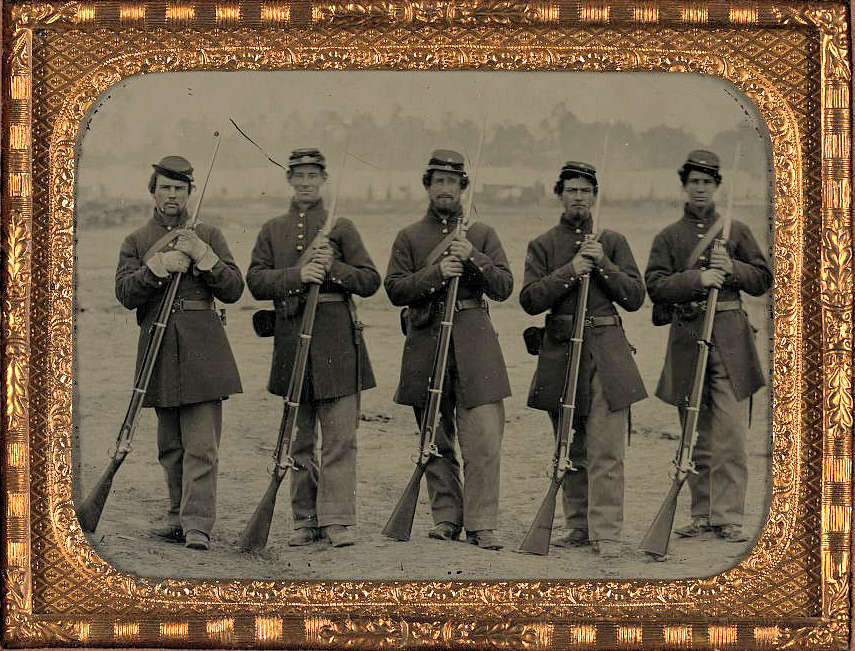
U.S. Secretary of War Jefferson Davis, future president of the Confederacy, adopted the rifle-musket and Minié bullet for the U.S. Army in 1855. An improved version of the rifle-musket, the model 1861 built by the federal armory in Springfield, Massachusetts, became the infantryman’s weapon of choice for Union soldiers in the Civil War.
Weighing just shy of 10 pounds, the Springfield sported a 40-inch barrel with a side-mounted 18-inch bayonet. The 58 caliber bullet used in the Springfield was slow, only 950 feet per second, which is about the same speed reached by a modern 22 bullet. But the gun was deadly accurate at long ranges. Armed with a Springfield, a man could hit a 27-inch bull’s-eye at 500 yards. A trained sharpshooter could consistently hit a four-inch target at 200 yards and a 6-by-6-foot target at 500 yards. At 1,000 yards, he could even hit an 8-by-8-foot target half of the time.
Frontal assaults by infantry columns, like those used during the late Napoleonic era, were now suicidal. Because the weapons were accurate at long ranges, defenders of a fixed position could load and fire quickly and hit their attackers. Because the advancing soldiers could not quickly stop to aim for return, their losses were much heavier than the defenders’.
In the hands of a sharpshooter, the rifle wreaked havoc on the gun crews of field artillery placed too close to the front lines. It became necessary to move the big guns to the rear, where the cannoneers were not exposed to sniper fire. The cavalry saw its role change, too. Historically, cavalry used their horses to trample foot soldiers armed with the highly inaccurate smoothbore flintlock muskets. But the rifle-toting Civil War soldier could hit a man at 200 yards. Officers on horseback were easy targets, and as the war continued, more and more cavalrymen fought as mounted infantry, using their horses for mobility and then dismounting to fight on foot. They became the forebears of today’s mechanized infantry.
Unfortunately, it took most of the Civil War before the generals realized the tactics used so successfully during the recent war with Mexico were obsolete. Generals on both sides sent their men to specific deaths. In Pickett’s Charge alone, almost 6,000 Rebels were killed or wounded as they advanced uphill over a mile of open ground toward entrenched Union positions at Gettysburg. The equations and formulas of warfare had been changed completely, mainly by a simple firearm and bullet: the rifle-musket and Minié ball.
The deadly effectiveness (three times that of the smooth bore musket used during the Mexican-American War of 1846-48) of the rifle-musket loaded with a Minié bullet was primarily to blame for the Civil War’s appalling casualty rates. Between the years of 1861 and May of 1865, confederate kills were more than 110,000 Union soldiers and 94,000, and an additional 275,000 and 194,000, respectively, were wounded.
The Minié bullet, the ounce of death itself and now known as “the widow maker,” caused 90 percent of all these casualties.








Comments