Mary Grizzard is a highly informed Texas Master Naturalist and an active volunteer at the SPI Birding Nature Center and Alligator Sanctuary. She has bountiful knowledge of the environment and countless hours of habitat work to her credit.
It happened so fast. One day the vacant lot at the end of our street, filled with native Yellow Sophora, Wooly Croton, and Bushy Bluestem was swaying rhythmically in the afternoon sea breeze, and the next day it was a dozer-scraped pile of dirt and a mass of pulverized vegetation. Not that it had been a particularly beautiful spot. It was unkempt looking and overgrown. And its destruction certainly wasn’t a malicious act — it’s just what happens when new construction begins. Still, it made me gasp. This little “weedy” habitat adjoining a tidal wind flat had provided food and shelter to an unknown number of creatures, from crabs to lizards to nectaring butterflies to shorebirds seeking a respite from the wind — and suddenly it was gone.
This has been the story for 95% of the Rio Grande Valley. Land is cleared for agriculture, for industry, for business and for residential development. Native plants are plowed under, most of them never to return. Indigenous butterflies lose their host plants. Native pollinators lose the nectar sources they depend upon. Migrating and resident songbirds lose the trees and shrubs they need for shelter, foraging, and their unique nesting requirements. Eventually residential neighborhoods and most businesses re-landscape the area, but, until fairly recently, this was usually done with non-native plants that never set root in the RGV until Europeans arrived. Attractive, hardy, fast-growing —these ubiquitous plants from other continents, like Oleander and Bougainvillea, have become so familiar to us that we just accept them as part of our landscape. But a Gulf Fritillary won’t lay her eggs on Bougainvillea because her caterpillars will only eat Passionflower leaves. And migrating Monarchs can’t nectar on Oleander because oleander doesn’t even produce nectar!
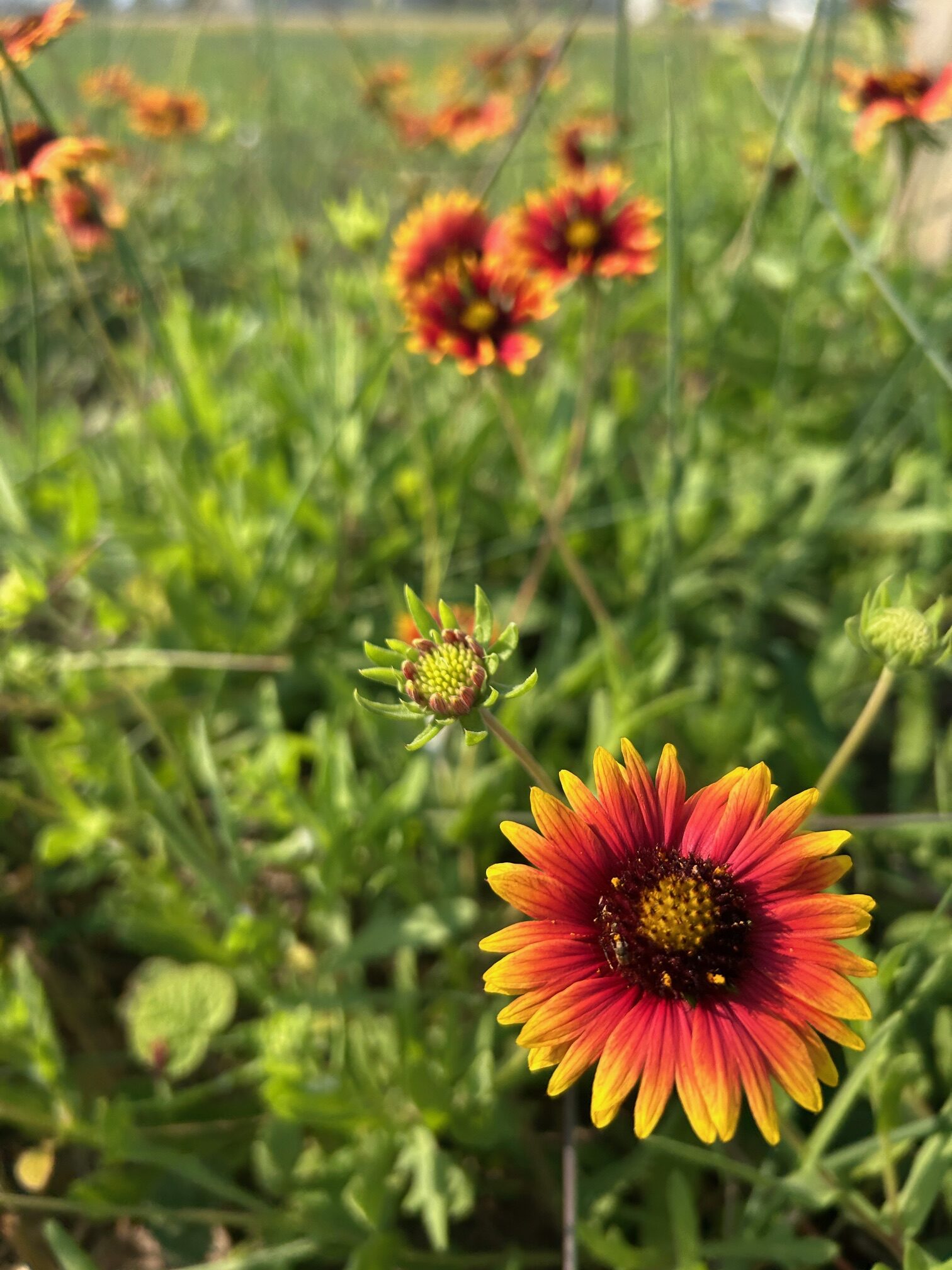
There’s another vacant field at the end of our street, on the opposite side of the scraped and bulldozed lot, and right now it is electric with the reds and yellows of Indian Blanket, Gaillardia pulchella, and the shining gold of Meadow Evening Primrose, Oenothera pilosella. Both of these breathtaking wildflowers are RGV natives, and both have been given the designation “Special Value to Native Bees” by pollination ecologists for their ability to attract large numbers of native bees. Both flowers are excellent nectar sources; both serve as host plants for several moth and butterfly species. And the fact that both of these wildflowers are thriving in a sun and salt blasted, often windy vacant lot in soil that is mostly sand and clay and is only watered by occasional rainfall is a testimony to how easy they are to use in home landscaping! Evening Prairie Primrose blooms all spring; Indian Blanket produces flowers from spring to autumn and even longer, providing weeks to months of nectar for hungry pollinators.
There’s a very large “For Sale” sign in this field of Prairie Evening Primrose and Indian Blanket. It’s been there for a long time, a few years at least, but I am painfully aware that this little prairie-like wildflower habitat could vanish overnight. And that’s why it’s so important for us to be proactive in restoring native habitat, to be one step ahead in protecting plant species which are so crucial to the RGV. Just last week, both the city of SPI, and the South Padre Island Birding, Nature Center, and Alligator Sanctuary planted a combined 600 plus native plants in parallel visionary efforts to mitigate native habitat loss on the island. It’s especially exciting when large organizations become involved in this mission, because they have the resources to go big. Yet even one individual can make an important contribution. Just last week friends of ours shared how they visited a local native plant nursery and bought indigenous Frogfruit as groundcover for their backyard. No effort is too small!
And here’s yet another thing we can do. If you know of an upcoming new construction project, please contact our local chapter of the Native Plant Society of Texas (rio-grande-valley-chapter@npsot.org). They will reach out to the land owners and, with permission, visit the involved parcel of land to assess whether there are any native plants that can be rescued. Some species transplant very well. Native milkweeds, for example, the only plants upon which Monarch butterflies lay their eggs, are often found growing few and far between, but these can be transplanted to other locations where they will continue to grow as essential host plants for the Monarch. With awareness, dedication, and perseverance, we can all help ensure that native plants return to, and thrive, in the RGV.







Comments