
By M. Kathy Raines
Chatting merrily as we walked along the jetties at Isla Blanca Park one May afternoon, my sister and I came to an abrupt stop.
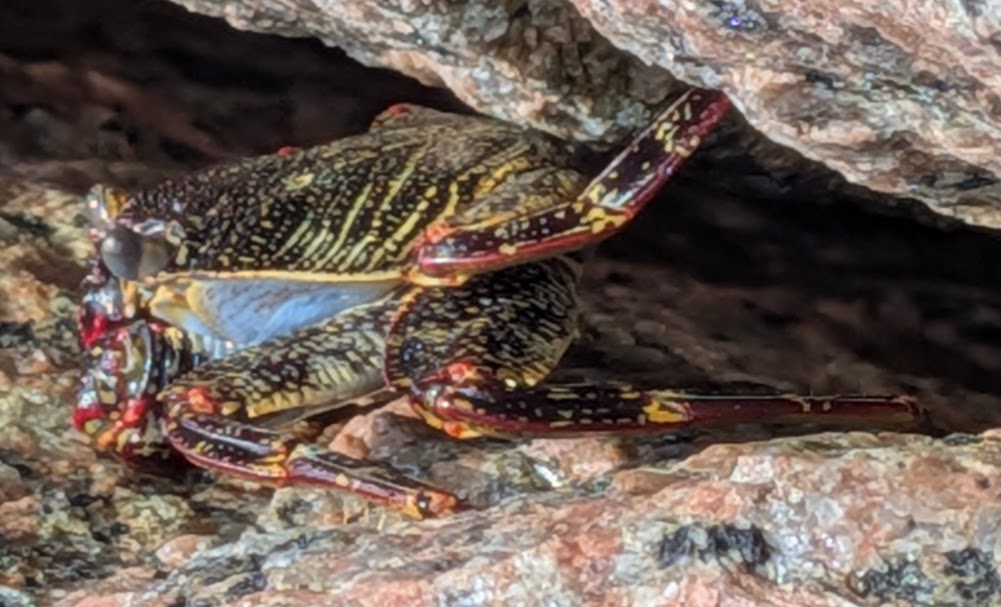
An astonishingly vivid crab, like a burst of fireworks, stood on our path, its reds, yellows and blues stark against the pinkish granite. Then, artfully flattening its body, it slipped into a deep crevice, suggesting sparklers as it clambered down.
For decades, I’ve loved walking the jetties, watching sea urchins and sea hares, dolphins and turtles, pelicans and egrets. Once, to my delight, a brown booby—a rarely visiting seabird—rested on a concrete stump. And now this gorgeous crab.
The Sally Lightfoot crab (Grapsus grapsus) is best known as a resident of tropical regions such as the Galápagos Islands, but it can also be found along rocks and jetties in the subtropical waters of the Gulf.
According to Laura George Grayson, program manager at the UTRGV Coastal Studies Laboratory, these crabs likely go unnoticed because they are neither considered a nuisance nor sought after as food. Although she has observed them locally, their remarkable speed and agility have made them difficult to collect for study.
Their nickname, “Lightfoot,” is well earned.
Also known as the red rock crab, the Sally Lightfoot seems to glow against the pink and gray granite of our jetties. Yet those bright colors may actually help protect it. Scientists believe the crab’s bold markings create a form of disruptive camouflage, making it harder for predators to distinguish its outline among the rocks.
Juvenile crabs are dark brown or black, becoming more colorful as they mature. Their flattened bodies allow them to cling tightly to rocks, while their pointed legs help them navigate slippery surfaces and withstand crashing waves.
An adaptable eater, the Sally Lightfoot crab feeds on algae, barnacles, dead fish and other marine material. It inhabits the intertidal zone between high and low tides, often sheltering in rock crevices during the hottest parts of the day to avoid dehydration.
Watching one move is a spectacle in itself. The crab darts through shallow water, vaulting across rocks and abruptly changing direction to evade predators such as seabirds, octopuses and moray eels. If threatened, it may pinch, squirt water or even sacrifice a leg, which will eventually regenerate.
Like many crabs, Sally Lightfoots molt several times as they grow, shedding their exoskeletons and emerging larger and often more colorful than before. They rely on sharp eyesight, chemical receptors and highly sensitive leg tips to locate food and detect danger.
Although not considered endangered, Sally Lightfoot crabs face many of the same environmental challenges affecting marine life worldwide, including warming waters, ocean acidification, harmful algae blooms, habitat loss, pollution and oil spills.
The next time you stroll the jetties at Isla Blanca Park, take a moment to look closely among the rocks. You might just spot one of the most colorful residents of the Laguna Madre—an unexpected splash of red, yellow and blue hiding in plain sight.









Comments