
By: M. Kathy Raines
Special to the PARADE
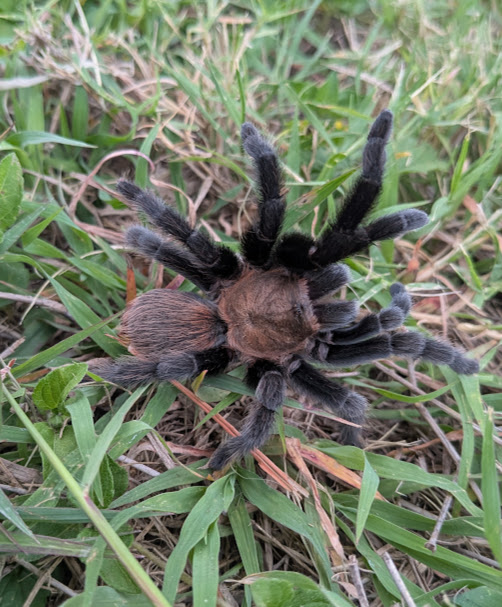
Wheel-like, the tarantula reared itself onto four legs, “arms” waving, revealing a velvety black underside and fangs.
Astonished, I doubled back as I rode past him on my bicycle in early May on the Brownsville Historic Battlefield Trail north of Alton Gloor in Brownsville.
With his peculiar posture, I wondered if he was being preyed upon by a tarantula hawk—a wasp that bites a tarantula, paralyzes and lays an egg upon it to provide sustenance for an eventually hatching larva. (Locals call the wasp chupa hueso, or “bone-sucker”). Years ago, to my shock, I witnessed this wasp dragging away a docile, much larger tarantula. Tarantulas resist, sometimes dining on the wasp as a reward, but this one evidently lost the fight.
But no wasp was present—just an oddly upright tarantula. Concerned, I found a sufficiently stiff blade of grass to reset him on all eights. But he promptly stood back up. Soon, he was climbing my bicycle wheel. I pried him off and let him be.
Later, I learned he was a “he”—not that I cleverly examined his body. In fall and spring, males of our commonly occurring species, the Texas tan tarantula, roam in search of a mate. Females stay in or near their burrows.
The tarantula’s erect posture, I learned, was defensive. Some creature—perhaps I, pedaling past—startled him, so he stood up to appear larger, plus exhibit his fangs. I had skirted him by at least a few inches, but he, with his ultra-sensitive setae (tiny bristles on his legs and elsewhere), may have felt vibrations from my tires on the asphalt as I approached.
To further dissuade a foe, a Texas tan tarantula may, using its back legs, scrape off and fling urticating, or stinging, hairs, which can provoke intense itching, rashes, respiratory distress or even temporary blindness. (“Urtica” is Latin for nettle, a stinging plant). As with nearly all spiders, these tarantulas inject venom as they bite, but a nonallergic person feels pain no worse than that of a bee sting.
The Texas tan tarantula (Aphonopelma anax), one of the largest of about fourteen Texas tarantulas, is black with a brown cephalothorax (head plus thorax) and abdomen—which holds its silk-producing spinnerets. It bears reddish hairs, and its leg span may reach five or six inches. Females appear bulkier, but males have longer legs, plus, they grow bulbs at the end of their pedipalps—small multipurpose appendages near the mouth that sense and manipulate prey and, for males, transmit sperm. Like most spiders, the tarantula has eight eyes, two circular ones in the middle andthree on each side. Fangs emerge from its cephalothorax, near its mouth.
This tarantula’s genus, Aphonopelma, means “soundless” in Greek, and its species, annex, denotes the “sole of the foot” in Latin, reflecting the spider’s quiet movement. Setae on its feet allow it to silently grip surfaces as it moves.
The name “tarantula” derives from an Italian seaport, Taranto. It originally denoted a local wolf spider, which residents called “tarantula”. The Tarantella, a perennially popular Italian folk dance, originated there in the fifteenth century. Increasingly frenetic, the dance allegedly cured tarantism, or a mania experienced by women thought to have been bitten by tarantulas. Women, with other eager participants, danced for hours to supposedly expel the spider’s venom.
The Texas tan tarantula thrives in grasslands, fields and deserts of South Texas. It digs or retrofits a burrow—which it seldom leaves— or couches itself into a crevice or wood pile. The tarantula lines and tops its burrow with silk, which provides stability and helps it detect both prey and predators like snakes or hawks.
An ambush hunter, this tarantula awaits vibrations of prey—often a cricket, caterpillar or beetle—then, providing the creature doesn’t fight back, it pounces, piercing its victim and injecting enzymes to liquify it. Then it slurps it up.
Tarantulas mature slowly, molting their exoskeletons regularly, with males maturing at from five to eight years, and females, from eight to twelve. After his last molt, a male develops hooks on his front legs with which, when mating, he can elevate the female and restrain her fangs. The male, ejecting silk from his spinnerets, creates a sperm web. Into this he deposits sperm, which he then loads into his palpal bulbs, or copulatory organs.
Seeking a mate, the tarantula may tap on or near the entrance to a female’s burrow from which she, if willing, pops out. He dances to entice her, but, if unreceptive, she may eat him. If she’s interested, he, with special syringe-shaped claws on his pedipalps, places a container of sperm in her abdomen. Then, to avoid being devoured, he makes a hasty retreat. She packs sperm into two pouches for sometimes months-long storage.
The female weaves a silky egg sac within which she lays hundreds of eggs, guarding them for seven or eight weeks until they hatch. Spiderlings stay a few days before dispersing.
These fascinating, rather docile creatures are popular pets. Though Texas law does not prevent them from being taken from the wild, anyone wanting to buy or sell them must obtain a permit. While a female may live over 20 years, a male lives a mere 7 to 10. A male usually dies within a year of mating.









Comments