
By: M. Kathy Raines
Special to the PARADE
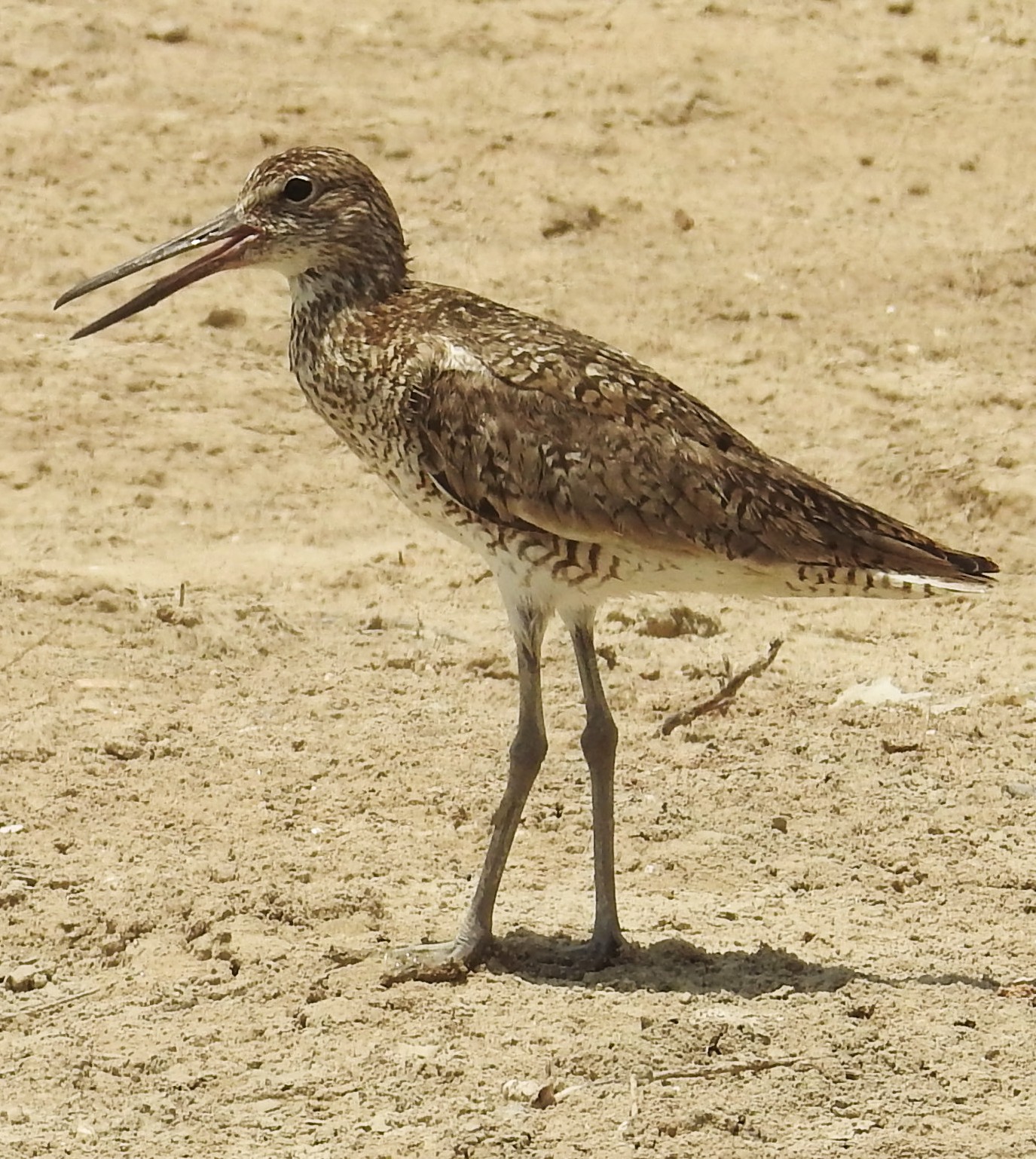
One willet, then another, helicoptered right in front of me, squealing. And their scolding intensified as I crept farther into the sticky mud towards the mangrove and fiddler crab-filled washes in the mudflats along the Jaime J. Zapata Memorial Boat Ramp in early June. This spirited couple undoubtedly had a nest or nestlings nearby.
An angel in one ear told me to leave these birds alone, lest they abandon a nest, while a more selfish messenger said to further investigate. Though sorely tempted, I heeded the angel and ceased my incursions. Any discovery, while satisfying, would benefit neither the willets, nor the scientific community. (Even well-intended ecotourists can harm wildlife).
Previously, I’d barely noticed these plain jane birds, as one hardly notes a laughing gull or tiger-striped cat. I often saw willets walking along the beach or mudflats, appearing mostly gray till they took flight, revealing black and white wings.
Both the eastern and western subspecies of willet (Tringa semipalmata) thrive on our beaches and mudflats, but in different seasons. The eastern willet (T.s. semipalmata) breeds here—the only one of our numerously appearing sandpipers to do so.
Some time after these willets fly off to winter in Ecuador and thereabouts, the western willet (T.s. inornatus)—which breeds on inland prairies in the Northwest and Canada—replaces them. Unaware of the difference, I long thought them one and the same, but the eastern is thicker-billed, darker and smaller.
The bill tips of a willet, like those of its fellow sandpipers, are packed with nerve endings, as well as taste buds, that readily detect prey in sand and mud. Depending upon circumstances, a willet employs varied techniques for catching invertebrates like crabs, snails, marine worms and insects, as well as small fish, along mudflats, beaches, pools and flooded fields. Seeking prey, the willet sweeps its submerged bill back and forth or up and down, or it lifts and pushes mud, sand or grass aside, retrieving what is underneath. It sometimes seizes a creature near the water’s surface or, with its bill slightly open, submerges itself to pursue small fish, especially when water is cloudy. A willet eats small clams whole. Seizing a crab by its legs, it gives it a shake, then devours it, legs first.
Eastern willets appear to be quite faithful to their mates, regardless of where they have wintered. If not previously paired, willets engage in aerial courtship displays, one, with the male flying above, wings uplifted and quivering its primary feathers while the female hovers beneath. As they access nesting areas, the couple performs nest-scraping actions, with the male, clattering, taking the lead. He depresses an area with his bill and sometimes his feet, presses his breast into it and sits. He leaves, and she sits. This occurs three or four times. They fill the ground nest with materials like grass, stems and twigs.
Both parents incubate the pair’s four olive to brownish eggs, which hatch in about 25 days. The precocial (independent), downy chicks leave the nest in a day or two, ready to peck at vegetation for invertebrates.
While parents do not feed chicks, they guide and supervise them, make alarm calls and, if necessary, mob predators. While the female leaves them in a couple of weeks, the male remains longer, assuring they can fly.
By early to mid-July, eastern willets depart for wintering grounds in South America.
The bird’s name derives from its typical “pill-will-willet” call, one used during courtship, defense and to maintain contact.
In flight, the call is continuous. Other vocalizations include a “kyah”, one made when crossing another’s turf, to maintain contact and to confirm the need to mob an intruder. A fearful willet may also make a high-pitched scream of alarm or a low staccato “cluck” or “kleep”. Willets, some of the quieter shorebirds, are usually silent during incubation and during nonbreeding times. Willets live among a variety of shorebirds—including curlews, godwits, dowitchers and Wilson’s plovers— many of which steal from one another.
Besides avoiding or combating its many predators and egg-thieves—including owls, hawks, rats and snakes—willets must contend with human beings who drain wetlands, drill for oil or gas nearby or use contaminants thoughtlessly. Prior to the Migratory Bird Treaty Act of 1918, so many people took willets and their eggs for food that they nearly disappeared from some parts of the country.
As we look after our breeding eastern willets and wintering western ones, we must consider conditions in the birds’ winter homes. While eastern willets breeding along the Atlantic appear to winter in relatively undeveloped areas in Central and South America, our Gulf willets apparently winter on parts of the Pacific coast, like in Ecuador, where their natural habitat is widely dominated by shrimp farms. Also, some people in the neotropics—as we once did here—continue to consume willets and their eggs. Following is a fascinating video concerning the distinctive wintering grounds of eastern willets that breed in the Gulf and those doing so along the Atlantic coast: https://www.youtube.com/watch?v=PcTLAPxMLIw









Comments