
By M. Kathy Raines
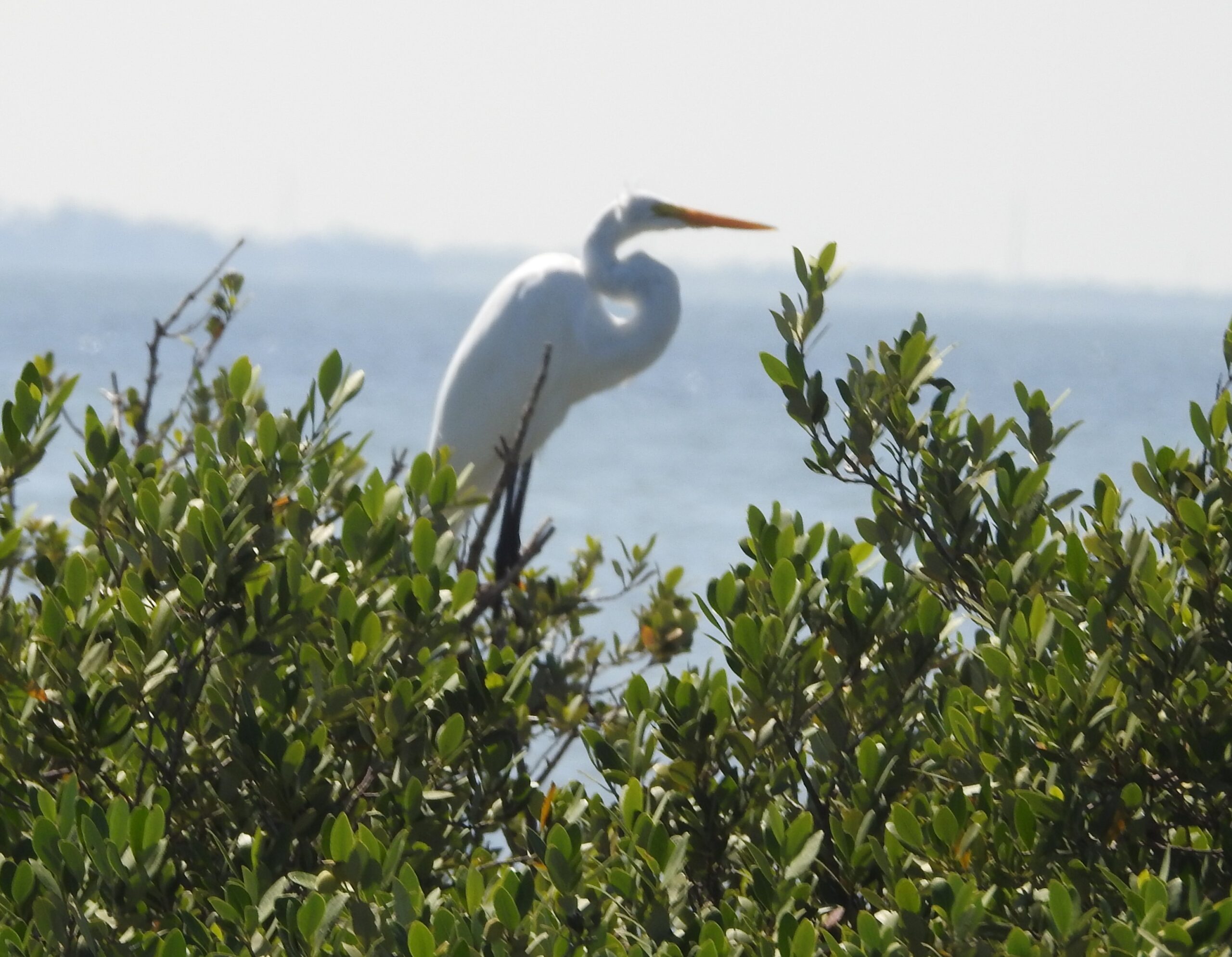
Astride a mangrove branch, the great egret stood tall, its sinuous, S-shaped neck touching a milky back. In a commixture of grace and severity, its intense eyes and bladelike bill pointed towards Laguna waters.
Amid the jubilance of discovering prettily colored warblers refueling during spring migration, we mustn’t forget our lovely natives, several of which, like the great egret, have adorned themselves in splendid breeding attire. During breeding, both male and female great egrets grow a spray of “nuptial plumes” called aigrettes (French for ‘egrets)—veils of lacy feathers—as well as lime green lores, or spaces between the bill and eye.
But loveliness can prove fatal. In yesteryear—prior to the Migratory Bird Treaty Act of 1918—people caged and marketed dazzling painted buntings and sweetly tuneful northern mockingbirds. Late nineteenth and early twentieth century hat-makers and clothiers killed thousands upon thousands of birds—nearly wiping out great egrets in some places—to decorate fans, dresses and hats, some of which bore entire bird wings. Merchants might kill roughly 150 to 200 birds to amass two pounds of egrets’ aigrettes. At times, plumes were worth more than gold. Thankfully, great egrets have revived, and, since 1953, this egret’s graceful image has been the logo for the National Audubon Society.
Though locally prevalent, great egrets are fascinating, sometimes even amusing, to observe. Occasionally, I see an egret wading through the Laguna Madre with its long, wormlike neck tilting at a 45-degree angle as if wafting in the wind, its eyes peering aslant at the water. Then it abruptly snares a fish. Many an egret stands on the jetties, motionless but alert, seemingly impervious to passersby, carefully scouring Gulf waters for fishy stirs.
The great egret (Ardea alba) lives in temperate to tropical waters worldwide. The species contains four subspecies, the American being egretta. Members of each behave and vocalize distinctively according to region, some being habitually wary around humans, others, less so. An egret, in the class, Ardeidae, is a type of heron. Unlike our smaller snowy egret, distinguished by its black bill and “golden slippers”, the great egret has a yellow bill and black feet. Common in wetlands, great egrets breed mainly in coastal areas.
Great egrets, like other herons, employ several hunting techniques, chief among them to stand and wait, then abruptly strike. Egrets also walk slowly, occasionally churning up water with their feet or vibrating bills to flush prey. Flying low while dragging their feet on the water’s surface may also arouse fish. Herons, rather than spear prey during attacks, open their bills a tiny bit to grasp it, according to ornithologist David Allen Sibley. Besides fish, great egrets eat other aquatic creatures, as well as insects.
Remarkable for creatures unschooled in math and science, egrets can counteract refraction— or reflected light that bends at surface waters—that masks a fish’s location. Researchers have observed egrets targeting their bills at angles to correct for refraction, rarely missing their prey.
Colonial nesters, great egrets breed in Texas from March through August, and the entire process, from site selection to the young’s departure, lasts about 90 days. It is a complex affair, involving myriad displays. A male selects a site and, using long sticks, builds a platform, and displays to a female, who responds in kind. In one technique, the Stretch Display, the male, neck retracted, turns away, then stretches his neck out, with his bill upwards. Then he retracts his neck and fans aigrettes, sometimes raising his body so it touches the back of his head, perhaps with accompanied nasal vocalizations. In the Snap Display, he stretches out his head, crouching till his abdomen reaches a branch, then, snapping his bill, raises and fans his aigrettes. He and his accepted female have an approximately week-long trial bond during which they copulate and ritualistically build and then defend their stick nest.
Assumedly to strengthen their pair bond, the couple engages in other rituals, one of which is Bill Grasping, in which both birds, raising their necks in S’s, grasp each other’s bills, raising their crests and fanning aigrettes. Also, they may perform Back Biting, in which both birds, bills slightly ajar, comb through one another’s feathers. About a fifth of these trial bonds, however, dissolve before egg laying.
An egret lays from three to five light blue eggs, and both parents assist with hatching by inserting their bills between the nestlings and eggshell shards. Initially, the parent deposits regurgitated food in the nest. Then, in a scene reminiscent of an unruly class of seventh graders, raucous chicks grab and pull at a parent’s bill, almost up to its eyes, to retrieve food. Competitive siblings squawk and stab at each other, occasionally even killing a nestmate, especially when food is scarce. Both parents care for chicks, who become independent after from 62 to 67 days.
Great egrets, who, like most birds, communicate most during breeding season, make croaking, guttural, nasal and rattling calls. They also assert their wills by snapping their bills together. They stretch their necks forward with their legs out in flight. To ward off competitors, egrets stab, counter-stab or displace one another.
Great egrets, having recovered from possible extinction due to plume hunters, are faring well, for the most part, though increased land development and drainage of wetlands are worrisome, and Florida has seen waning numbers in the Everglades. This egret is an indicator species, one whose welfare suggests the wellbeing of others. To their advantage, great egrets thrive eat an assortment of prey and thrive in a variety of locales.









Comments